What an Adaptog Certificate of Analysis shows, how to match it to the unit in front of you, and where to find it.
Every Adaptog research material is supplied with batch documentation, and the most important document is the Certificate of Analysis, or COA. This guide explains what an Adaptog COA contains, how to match it to the unit you hold, and where to find the original report.
What is an Adaptog Certificate of Analysis?
A Certificate of Analysis is a report from a laboratory that states what was tested, how it was tested and what the results were, for one specific batch. At Adaptog, identity and purity are confirmed per lot by independent laboratories, using methods such as HPLC and LC-MS. The method, the results and the laboratory are all stated on the report.
Step 1: find the batch code on your unit
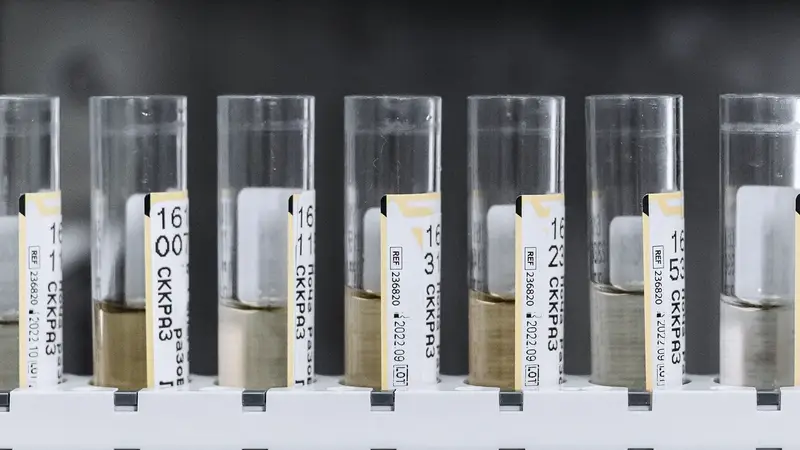
Every Adaptog unit carries a lot or batch code printed on the label. This code is the link between the physical unit and its documents. Write it down before you look for the report.
Step 2: find the report in the Adaptog COA library
Published Certificates of Analysis are held in the Adaptog COA library and can be searched by batch code using the batch lookup. Each report is the original document from the testing laboratory.
Step 3: check that the report matches
Compare the batch code on your unit with the batch code in the COA header or filename. They should be identical. If they do not match, or your batch is not listed, contact the Adaptog team with the lot ID and we will send the correct document.
Step 4: read the results
When you read an Adaptog COA, look for these elements:
- The laboratory. The name of the independent laboratory that carried out the analysis.
- The analysis date. When the testing was done.
- The method. For example HPLC for purity, or LC-MS for identity.
- The results. The measured values, such as purity as a percentage, and the confirmed identity.
An HPLC result shows how much of the sample is the target compound. LC-MS confirms identity by measuring molecular mass. Together they answer the two questions most laboratories care about: is this what it says it is, and how pure is it?
Understanding HPLC purity results
HPLC stands for high-performance liquid chromatography. A dissolved sample is pushed through a column packed with fine particles. Different compounds travel through the column at different speeds, so they leave it at different times. A detector records each one as a peak on a chart called a chromatogram.
When you read the HPLC section of an Adaptog Certificate of Analysis, a few terms come up again and again:
- Retention time. How long a compound takes to pass through the column, usually in minutes. The main peak should appear at the retention time expected for the target compound.
- Peak area. The size of each peak. Purity is normally calculated as the area of the main peak as a percentage of the total area of all peaks.
- Purity. The headline percentage. A purity of 99% means that, by this method, 99% of the detected material was the target compound.
- Impurities. Any smaller peaks. These can be related substances, breakdown products or residues from synthesis.
HPLC purity is relative to what the detector can see. That is one reason laboratories pair it with a second method, rather than relying on a single number.
Understanding LC-MS identity results
LC-MS combines liquid chromatography with mass spectrometry. After the compounds are separated, the mass spectrometer measures the mass of each one. For identity testing, the question is whether the measured mass matches the expected molecular mass of the target compound, within the tolerance the laboratory states.
On an Adaptog COA, the LC-MS result usually appears as an expected mass, an observed mass and a conclusion, such as "conforms" or "identity confirmed". If the observed mass matches the expected one, the material is what it is labelled as.
Common questions when reading a COA
- Why do two batches of the same product show slightly different purity? Every batch is made and tested separately, so small differences between lots are normal. That is exactly why each Adaptog COA names the batch it describes.
- Why is the analysis date earlier than my delivery? Testing happens before a lot is released into stock. The COA records when the testing was done, not when your order shipped.
- Can I share a COA with my quality team? Yes. Reports in the Adaptog COA library are published so they can be checked by anyone who needs them.
What a COA does and does not prove
A COA describes the batch that was tested. It is strongest when combined with traceability (the batch code on your unit) and your own incoming checks. Adaptog also uses NFC verification, which confirms that a tagged unit is still linked to its original batch record. Our article on Adaptog batch traceability explains how these pieces fit together.
Other Adaptog documents
Where one exists, Adaptog also provides a Safety Data Sheet (SDS) and a Technical Data Sheet (TDS), covering hazards, storage, handling and technical characteristics. Both can be requested from support. For more on how testing is organised, see Assurance at Adaptog.